October 7, 2010

7/31 Art

Hannah detested coloring/writing/scribbling until she was 5 years old and no longer had an OT telling her what to do.    She avoided scissors like the plague.

Then one day she discovered crayons and coloring books.  And my life was easier.   Any time we had to wait at a doctor's office, or a restaurant, she was thrilled to fill her time with coloring.  Long car trips?  She could color for hours.  A new coloring book was a favorite gift.  A pair of scissors and some construction paper kept her occupied for quite a while. (And even longer when she had to clean up the mess!).   Throw in a hole punch and she'd be set for an afternoon.

As the years went by, she discovered that she liked to draw as well.  At her peak, she probably did some kind of coloring, drawing or painting for 2 hours a day.  She started taking art classes a couple years ago.  Her creations in class are quite different from the ones she does at home.   She doesn't have much carry-over.   That carefully executed self-portrait made in class is the only one that has any sort of real proportion.   That's okay.  We enjoy all that she creates.   I really wasn't expecting a child of mine to be artistic.   I am lucky if I can draw a stick. (No, not a stick person, just a stick.)    My idea of painting is using a roller on a wall.   James can draw.  He will sit and draw or color with Nan.  Me?  I'd rather bake muffins.

Hannah's moved past her "tape" phase of 6 months ago.  (Sorry to disappoint you Chrystal!)
In the spring she took a pottery class. She doesn't yet have the finely graded muscle control to use the wheel, but she has made some nice handwork pieces.
(that's a yellow turtle in the front)


This vase was my Mother's Day gift.


When she's motivated, she'll get out her paints.  We have a variety of paints, but usually she just goes with the Crayola washable poster paints.  She really that Little Tykes would make a tall version of their easel.  All the "adult" sized easels I see are not sturdy enough for her.  So she uses a tabletop easel left over from Occupation therapy.   
 
This one surprised me.  I don't know where she picked up the idea of a fruit bowl still life, but she created it from somewhere in her memory.

And this is one of my favorites. Again, from her memory.  She hasn't read Morris in a long time.


It's Morris the Moose (a very funny beginning level set of stories).  I like it because I think it shows that she tool some thought to figure out where to leave paint out.  She planned to leave the teeth white.  The visual processing is amazing to me.


If you haven't read Morris stories, I recommend them.  I prefer Morris over Amelia Bedelia.   The books are simpler than Amelia Bedelia, so the humor is more obvious. (And let me tell you, a concrete learner does not understand Amelia Bedelia.  She IS Amelia Bedelia.)

Having an artist in the house was the last thing I would have expected when Hannah was a preschooler.  Some things are best left alone to be figured out on their own time line.  I'm glad we dropped OT.  It gave her the freedom to explore on her own terms.

October 6, 2010

6/31 Adolescence. Yes and No.

My girl is turning into a teenager.   Not officially, of course, but in attitude.

Adolescence is really quite humorous when you're not the one going through it.   I always enjoyed watching my capable children completely flounder with simple tasks, just because their brains are drowning in a bath of hormones.

Hannah's not yet there, but she is getting an attitude with me.   She's short with me, and can be rather rude.   As with most adolescents, she thinks it's my fault--that I'm the one who is changing.   I try to give her as much independence as possible, but there are times when I need to supervise.   She is not pleased.

I was talking to Kate about this on Skype (the best invention ever!).  She can see it/hear it when Hannah's Skyping with her.  When Nan's turn on Skype should be over, she cops an attitude.  Kate will say, "Hey! Be nice to Mom!"   Hannah usually responds with an indignant sigh.

I know these are all signs of typical emotional development (at least in the USA), so this a good thing.   But some times I feel like I got cheated!   I was told that she'd be more like a baby for a longer period of time.   I was told that she would be slow to develop and slow to reach milestones.  Well, in this instance, that's totally out the window.   Where's my baby?  My child?  She's just 2 inches shorter than me too!  No fair!

Yes, she is maturing, but while she's testing the teenaged waters, she still keeps one foot firmly in childhood.   She still loves the Disney Channel.   She still plays with her doll house and Webkinz.  She self-talks with Woody and Buzz Lightyear.  She adores coloring books.  She uses these things to relax.  She works hard at learning and doing, and then she wants to have her version of zoning out.  She doesn't just want it, she needs it.  We all do (Hello Facebook? Solitaire? Blog reading?) .  It's our re-charging time.

These things are not bad; I'm really not complaining. It's just different--bridging the span of preschool interests all the way to hormonal mood swings.

It is just odd.

And there are few navigational charts to help me steer the ship.  She's a mystery.

October 5, 2010

5/31 NanTalk

At bedtime last night Hannah asked for a Nanwich.  That's when Mommy and Daddy are the bread and Hannah is the peanut butter.   We lie down with her, one on each side and cuddle her up.  A Hannah Sandwich.   We pretend she's not there and we teasingly talk about her, literally, over her head.  

We usually say things like, "Oh, did I mention how much l love our daughter?" 

Or, "I could not BELIEVE it today when Hannah cleared the kitchen table without being asked."  

Or,  "That Hannah has the stinkiest breath ever. That girl needs to brush her teeth!  P-U!" 

To which she squirms and wiggles and squeals out her pretend outrage.

But last night wasn't optimal for a Nanwich, James had work to do. So it was an open-faced Nanwich instead, with only one piece of Mommy bread.

We were snuggling and started to talk about her teddy bear, Molasses.  I told her about my favorite stuffed toy hippo when I was little.   She asked what it's name was.   It didn't really have a name.   

She asked if I named it Ralph.   

Me:  No. I wouldn't have named it Ralph because that's my brother's name.  You know, Uncle Ralph.   Would you name your bear Chris?

Nan:  No! I wouldn't. You should have named your hippo Anthony.


This reminded me of a book we used to have. "There's an Ant in Anthony"    

I knew she'd remember it, so I said, "There's an Ant in Uncle Anthony"

Giggles.


Nan:  You should have named your hippo Ant Ralph.    (get it?  Aunt Ralph?)

Then we took turns thinking of words that had "-ant" in them. Laughing after each idea.

She started it:   anti-body

Me: antagonistic

Nan:  ant hill

Me:  antidisestablishmentarianism

Nan:  antibiotic

Me: elephant

Nan:  Fran-tic   (very nice play on words using her very good friend Fran, whom she usually calls "Frand", her friend: three bonus points for Nan!)

Me:  Plant

Nan:  Sea Chanty   (I was impressed!)

Me: Dance   (dants)

Nan (running out of steam from laughing so much):  I can't.


She wins!!

And there you have it:  Thinking, without it being school.    She amazes me.  

(and yes, I did stop midway through to get a piece of paper to record the words.  My middle-aged brain needs some short term memory improvement)   


p.s. I am working on an upcoming Q&A post, so if you've got questions, send 'em in.  Email works better than comments for long questions, so I can reply and clarify--address is on the side bar ---> )


October 4, 2010

4/31 Prenatal Diagnosis Support

Hooray!  There is a new website created specifically for parents who have received a prenatal diagnosis of Down syndrome and plan to proceed with the pregnancy.   It looks great!  There is a free e-book on the site: From Diagnosis to Delivery: A Pregnant Mother's Guide to Down Syndrome.

Since we did not have a prenatal diagnosis, I can only imagine how difficult it is to process all the overwhelming feelings and information of an unexpected prenatal diagnosis.  I know how hard it was for us, even when we could see how beautiful our daughter was with our own eyes.  I am so glad that there is a website with accurate and supportive information for these yet-to-be parents.

If you'd like to help with this outreach, you can make a tax-deductible donation on the site:
Down Syndrome Pregnancy

October 3, 2010

0.0967741935

I think that 10 decimal points is enough. I changed my fraction routine into decimals in honor of my #1 niece, Elizabeth. She's a freshman at MIT, and she's a math whiz. And she has a great name. She's also the only person who took a guess at my literary mystery. And she got it right. Ms. Frizzle!

Now that has absolutely nothing to do with Down syndrome. But, at least I know one or two readers who will be pleased with the shout out.

Here comes the relevant part of the post:

The past two Saturdays I've been facilitating a Talktools DVD seminar. I know many of you have been hoping to find an OT or an SLP who has training in oral placement therapy. Well, this is one way to make it happen: Train them yourself! And, at the same time, you'll learn more than you can imagine!

It's not so difficult.

1. Talktools has Sara Rosenfeld Johnson's 3-Part Treatment Plan seminar available on DVD. It's 12 hours of training geared for OTs and SLPs. They earn 1.2 CEUs for attending (good selling point, especially since most therapists have to get a certain number of continuing ed credits to maintain their certification). You can either rent the DVD, or purchase it (or, talk to your local DS support group about getting it). It's pricey, but you'll come out even if you get just a few therapists to attend. Parents can attend as well, but it's a very heavy load of new terminology and can be overwhelming to some.

2. Decide on good dates and a good location (tables, chairs, computer/projection capabilities). Hospital conference rooms, libraries, churches all are possibilities. Don't forget that many school therapists cannot take a day off for training unless it is a teacher work day.

3. Publicize that you're offering training (I can send you my flyer if you want some ideas). Contact local schools and private therapy clinics. Contact local disability non-profits as well (Arc, Autism Society, UCP, etc). Invite parents to attend at a reduced cost (they won't need the CEUs, so the materials fees are lower).

4. Collect registration moneys at least two weeks in advance. You'll need to order "extra viewer kits" for each person in attendance. Place your order with Talktools.

5. Remember that you cannot "make" money by charging more than what you spend. That would be illegal. It's tricky not to do this...so either you can limit the number of attendees, or you can throw in a catered box lunch on each day, or you can refund some of the money back. Don't forget to reimburse yourself if you are paying to make and distribute flyers or have other related expenses.

6. Bring refreshments. Especially banana bread or mini-chocolate bars. It's hard to sit through 6 hours of DVD watching each day!


I've done this several times, sometimes just with parents, sometimes with therapists and parents. Everyone comes out bleary, but filled with new ideas and techniques.

Yesterday was the second day of the training. It was my smoothest event ever. It was terrific because I had the support of the Down Syndrome Association of Greater Richmond, who sponsored it. And I had some great helpers too (Thanks Lyn! Thanks Lancasters! Thanks James!). Richmond now has seven therapists and 14 more families who have the basics of Oral Placement Therapy!

You can make it happen, and your child and your community will benefit.

October 2, 2010

2.5/31 A bonus post!

Or, perhaps I can cash this in if I miss a day later on in the month?

While I was busy all day long (see tomorrow's post), James and Hannah went to the Virginia State Fair.  By all accounts they had a great time--they got to see farm animals, an agility dog show, bumper cars, and ate corn dogs (glad I missed that part).    Hannah played an arcade game to win a prize. Somehow she hit five balloons with three darts! So she is the proud owner of a stuffed animal--a pig she appropriately named Wilbur.

When I got home this evening, the first thing I noticed that Hannah also won her first bad sunburn of the year:

Yesterday it went through my mind to put out some sunscreen, but then I got a migraine and went to bed.  I didn't think about it again until I saw her.  Ouch.  She's all shiny with lotion and lip balm now.  Hope she'll fade quickly.

2/31 Schooling

Too bad that 31 is a prime number or I could have had some fun with fractions!

Fractions fractions.   Yesterday I was trying to teach Hannah the nuances of dotted quarter notes.   Her newest piano piece has introduced dotted quarter notes. She understands tying notes together, but the blasted dot surely doesn't look anything like an eighth note.

For those of you who don't know, a quarter note has a beat of 1.  If you fit two notes into 1 beat, you have two eighth notes.   If you want to stick one eighth note on to a quarter note (you'd get 3/8ths mathematically), you'd have to count 1.5 beats.    Does this make any sense?  Of course not.  


Hannah absorbed about ZERO of what I was explaining.   And I don't blame her.    She does understand basic fractions.  We have those tiles that are divided into various fractions, and she understands cutting something in half, and then in half again to get fourths (or quarters...as in money).   But music timing doesn't make much sense to her.   She usually just memorizes the rhythm and doesn't count beats at all.  She leaves that up to me.   I personally don't think it matters much.  It's not a required life skill.

This year, which we call Sixth Grade, we are focusing on academic life skills--the 3 Rs.   Hannah would be in 7th grade if she was with her age-mates.   We had a 2nd grade, and a 2nd-and-a-half grade, so she's a grade behind, by name only.   She really is working on a spectrum of skills that range from 1st grade - 4th grade.  Reading individual words (vocabulary words) is one of her strengths, and I'd guess she's close to a 5th grade level.  I don't really know, because I never test her.   She is where she is.  And I just work on the next step she needs to take.

I did some thinking this summer, trying to distill what is holding her back, where is she weakest, and I revamped some of our curricula. (By the way--TANGENT WARNING--one of my BIGGEST pet peeves is when a homeschooling parent who cannot spell the word curriculum!  You'd think that the error they make is with the plural.  I can forgive "curriculums".   But I cannot forgive "cirriculum".  Sir Iculum it is not.  I'm sure this spelling error is not limited to homeschoolers, but, let's face it, other than educators, hardly anyone else uses the word.  And besides, there is ALWAYS spell check.)

The areas that need the most attention are writing, spelling, and math. Yes, her penmanship is very tidy, but still slow.  It's slow because she spends so much time figuring out how to spell words.  If she has an idea/answer in her head, she'll say it out loud.  But by the time she's written the first word in the sentence, she's forgotten what she wanted to say because the idea left when she was concentrating on the motor task of writing, as well as the mental task of spelling.  It's not automatic.   And it hasn't improved over the past few years.

So I decided to go back to Sequential Spelling.  We tried it a few years ago, but didn't stick with it.  This time it seems to be working.  She'll even ask to do her spelling first!

Here are yesterday's words.   She doesn't get tested on them--she figures out how to add the prefixes and suffixes, and builds words within families.


(Yes, they actually use the word "treeing"--as in, "The hounds enjoyed treeing the squirrel.")

For Language Arts and Writing, this year we are using materials from The Well Trained Mind.


I'm starting back at the beginning, making sure that Hannah's not missing key components in language arts and writing.   For now, it's very easy for Hannah.  She is doing copywork, memorization (poems), and narration (re-telling a story I just read to her).   

I never used a "programmed" curriculum before.   It's so easy!  I sort of feel like a fake--saying exactly what the book tells me to say.   But she's eating it up, and making progress.  

I'm not so sure that she (or I) would have been ready for this approach a few years ago.  

Another thing I'm introducing this year is keyboarding skills. We haven't started yet, but I am hopeful that by removing some of the motor task elements her writing will improve.

For math, we are still using Numicon, but I'm also taking a closer look at the Teaching Math to People with Down Syndrome.   We'll be using more games, money and calculators this year.   She loves creating a "store" and counting out dollars, dimes and pennies (we're not adding nickels yet, and quarters are totally confusing).

I have to mention that this summer we added another supplement, Longvida Curcumin to her protocol.   I discussed it with her pediatrician (whom we adore), and after reading the research, she thought it was worth a try. We didn't observe any changes over the first 2 months.  But then we gave her a week-long boost at a higher dose. Since then, she has been very interested in numbers.  She is always counting things and using ordinal numbers.  "That's the 9th time you said that, Mom." (that's typed in Adolescent Eye Roll font.)      And she was right. But maybe she should have listened the first time, instead of counting.

Disclaimer, of course:  I have no way of telling if the two things are connected  Math : Longvida Curcumin.   But it isn't hurting.  But it is very expensive.

We do lots of other stuff--right now we're reading The Little House books together.   We throw in some geography, calendar work, Thinking Skills books, nature stuff, etc.   Today she wanted to work with a dictionary, so she invented a game using the Bananagram tiles (similar to Scrabble tiles), picking a letter out of the bag, then finding a word in the dictionary that started with that letter, and writing it down.  Fine with me!   I told her she could play it 12 times.  Far be it from me to interfere with that kind of "playing"!
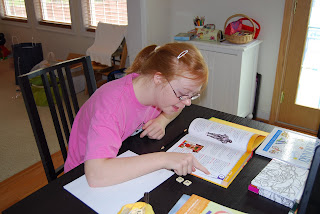

What I'm chasing down is not performance or mastery of any particular skill, I'd rather see her Think.  I want to help her learn to process information so that she can solve problems.   I don't think that average worksheets or memorizing math facts will necessarily will help her to do that.  I believe that reading good books results in good language patterns.  I believe that playing games can bring academic accomplishments and challenge social skills.  I believe that living life is much more effective a learning tool than learning about living life.

We spend focused learning time three or four times a week.  She can stay focused for 3-4 hours.  I should say that *I* can stay focused for that amount of time...I don't know how long she could last...